CPP Survivor’s Pension Guide 2026: Eligibility, Payment Amounts and How to Apply
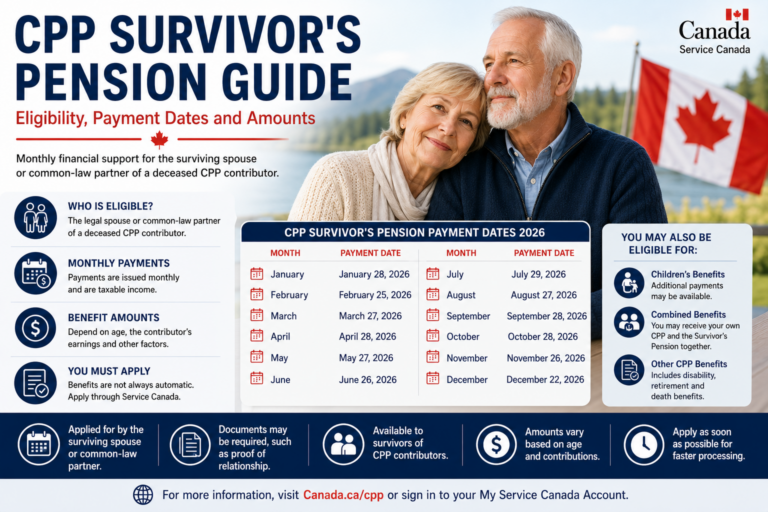
The CPP Survivor’s Pension is a monthly payment available to the legal spouse or common-law partner of a deceased Canada Pension Plan contributor.
The amount you may receive depends on your age, the deceased contributor’s CPP record and whether you already receive another CPP pension or disability benefit.
This guide explains eligibility, 2026 payment amounts, payment dates, how to apply and what happens when the survivor’s pension is combined with other CPP benefits.
CPP Survivor’s Pension at a Glance
- Monthly taxable payment for an eligible surviving spouse or common-law partner.
- Based partly on the deceased contributor’s CPP contributions.
- Different calculation rules apply to survivors under and over age 65.
- It may be combined with CPP retirement or disability benefits, but payment limits apply.
- You should apply as soon as possible after the contributor’s death.
What Is the CPP Survivor’s Pension?
The CPP Survivor’s Pension is a monthly benefit paid after the death of an eligible Canada Pension Plan contributor.
It is intended to replace part of the income lost by the deceased contributor’s surviving spouse or common-law partner.
The survivor’s pension is separate from the CPP Death Benefit, which is generally a one-time payment made to the estate or another eligible applicant.
Who Is Eligible for the CPP Survivor’s Pension?
You may qualify if you were:
- Legally married to the deceased CPP contributor.
- The common-law partner of the deceased CPP contributor.
- A separated legal spouse, provided the deceased did not have an eligible common-law partner and other eligibility rules are met.
For CPP purposes, a common-law partner is generally someone who lived with the contributor in a conjugal relationship for at least one year.
What if the couple was separated?
A separated legal spouse may still qualify when the deceased contributor did not have a common-law partner.
However, a separated spouse may not qualify if a CPP credit split involving the same deceased contributor was requested and approved in January 2025 or later.
What happens if you remarry?
Your CPP Survivor’s Pension normally continues even if you remarry or enter a new common-law relationship.
What if you are widowed more than once?
If you qualify based on more than one deceased contributor, only one survivor’s pension is generally paid. Service Canada pays the larger eligible pension.
How Is the CPP Survivor’s Pension Calculated?
Service Canada first estimates the CPP retirement pension the deceased contributor received, or would have received, at age 65.
The survivor’s pension is then calculated according to the survivor’s age and whether the survivor already receives another CPP benefit.
| Survivor’s age | General calculation |
|---|---|
| Age 65 or older | Generally 60% of the deceased contributor’s CPP retirement pension when the survivor is not receiving another CPP benefit. |
| Younger than 65 | Generally a flat-rate portion plus 37.5% of the deceased contributor’s CPP retirement pension when the survivor is not receiving another CPP benefit. |
CPP Survivor’s Pension Amounts for 2026
Your actual amount depends on the deceased contributor’s payment history and your own circumstances.
| Type of survivor’s pension | Average amount for new beneficiaries | Maximum monthly amount for 2026 |
|---|---|---|
| Survivor younger than 65 | $549.62 | $803.54 |
| Survivor age 65 or older | $339.36 | $904.59 |
| Combined survivor and retirement pension at age 65 | $1,103.97 | $1,531.56 |
| Combined survivor and disability benefit | $1,335.78 | $1,756.14 |
Average figures are based on new beneficiaries in April 2026. Maximum amounts may change over time because of CPP enhancement adjustments.
CPP Survivor’s Pension Payment Dates 2026
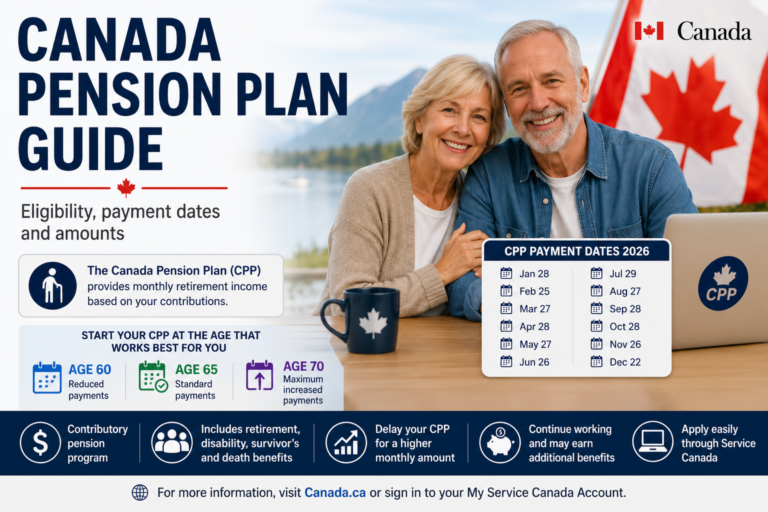
The survivor’s pension follows the general Canada Pension Plan payment schedule.
| Month | Payment date |
|---|---|
| January | January 28, 2026 |
| February | February 25, 2026 |
| March | March 27, 2026 |
| April | April 28, 2026 |
| May | May 27, 2026 |
| June | June 26, 2026 |
| July | July 29, 2026 |
| August | August 27, 2026 |
| September | September 25, 2026 |
| October | October 28, 2026 |
| November | November 26, 2026 |
| December | December 22, 2026 |
Direct deposit is usually the fastest and most reliable way to receive monthly payments.
Can You Receive the Survivor’s Pension With Other CPP Benefits?
Yes, but the benefits are not simply added together in full.
If you already receive a CPP retirement pension or CPP Disability Benefit, Service Canada combines the payments into one monthly amount.
| Combination | How it works |
|---|---|
| Survivor’s pension and CPP retirement pension | The combined payment is generally limited by the maximum CPP retirement pension rules. |
| Survivor’s pension and CPP Disability Benefit | The combined payment is generally limited by the maximum CPP disability amount. |
| Multiple benefits with flat-rate components | Only one flat-rate component, usually the largest, is paid. |
The enhanced CPP portion may be added separately and is not necessarily subject to the same maximum limits as the base CPP component.
How to Apply for the CPP Survivor’s Pension
You should apply as soon as possible after the contributor’s death.
CPP can generally issue retroactive payments for no more than 12 months, consisting of the month of application plus the previous 11 months.
- Gather information about yourself and the deceased contributor.
- Sign in to your My Service Canada Account.
- Complete the online CPP Survivor’s Pension application.
- Upload any supporting documents requested by Service Canada.
- Review your application and submit it.
You can also apply by mail using the Canada Pension Plan survivor’s pension and children’s benefits application form, known as form ISP1300.
Information and Documents You May Need
- Your Social Insurance Number.
- The deceased contributor’s Social Insurance Number.
- Information about your marriage or common-law relationship.
- Death-related documents if requested.
- Direct deposit banking information.
- Additional supporting documents requested by Service Canada.
Copies of documents are usually accepted, although Service Canada may request an original or certified copy.
When Does the Survivor’s Pension Start?
The earliest the survivor’s pension can begin is the month after the contributor’s death.
Service Canada states that receiving the first payment normally takes approximately six to 12 weeks after a complete application is received.
What if Your Application Is Delayed?
Applications may take longer when information is missing, documents require verification or the applicant’s relationship with the deceased needs further review.
If more than 12 weeks have passed since Service Canada received your complete application, you can contact the Canada Pension Plan to request an update.
CPP Survivor’s Pension vs CPP Death Benefit
| CPP Survivor’s Pension | CPP Death Benefit |
|---|---|
| Monthly payment. | Generally a one-time payment. |
| Paid to an eligible spouse or common-law partner. | Usually paid to the estate or another eligible applicant. |
| Amount depends partly on age and CPP contribution history. | Basic amount is generally $2,500, with a possible additional $2,500 top-up in qualifying cases. |
| May continue for life, subject to eligibility. | Paid once after approval. |
CPP Benefits for Children of a Deceased Contributor
Dependent children of a deceased CPP contributor may also qualify for the CPP Children’s Benefit.
This is a separate monthly payment and requires its own eligibility assessment. It may be applied for together with the survivor’s pension using the relevant application process.
Frequently Asked Questions
Is the CPP Survivor’s Pension taxable?
Yes. CPP Survivor’s Pension payments are generally considered taxable income.
Do I receive the full CPP pension of my deceased spouse?
No. The amount is calculated using specific CPP formulas based on your age, the deceased contributor’s pension record and any other CPP benefits you receive.
Can a common-law partner receive the survivor’s pension?
Yes. A common-law partner may qualify if the couple lived together in a conjugal relationship for at least one year and other requirements are met.
Can a separated spouse qualify?
Possibly. A separated legal spouse may qualify if the deceased had no eligible common-law partner, although CPP credit-splitting rules can affect eligibility.
Will the survivor’s pension stop if I remarry?
No. The CPP Survivor’s Pension generally continues after remarriage.
Can I receive a survivor’s pension from more than one deceased spouse?
You cannot normally receive multiple survivor’s pensions in full. If eligible for more than one, the larger pension is generally paid.
How long does the application take?
Service Canada indicates that the first payment usually takes approximately six to 12 weeks after receiving a complete application.
Can payments be backdated?
Yes, but generally for no more than 12 months, including the month of application.
Can I appeal a denied application?
Yes. You can request a reconsideration if you disagree with a decision affecting your eligibility or payment amount.
Related Northbly Guides
- CPP Payment Dates
- CPP Disability Benefits Guide
- Canada Government Payment Dates
- OAS Payment Dates
- Canada Senior Benefits Guide
- Canada Benefits & Rebates Guide
Official Government Resources
Use the official Government of Canada website to verify current eligibility rules, payment amounts, application forms and processing information.
Official CPP Survivor’s Pension InformationFinal Thoughts
The CPP Survivor’s Pension can provide important monthly financial support after the death of a spouse or common-law partner.
Because the final amount depends on age, CPP contribution history and other benefits already received, it is important to apply promptly and review the calculation provided by Service Canada.